Don't Forget the Lyrics
- 4.3
- Rating
- 5.00M
- Installs
- Free
- Price

 Analysis by App-foxy
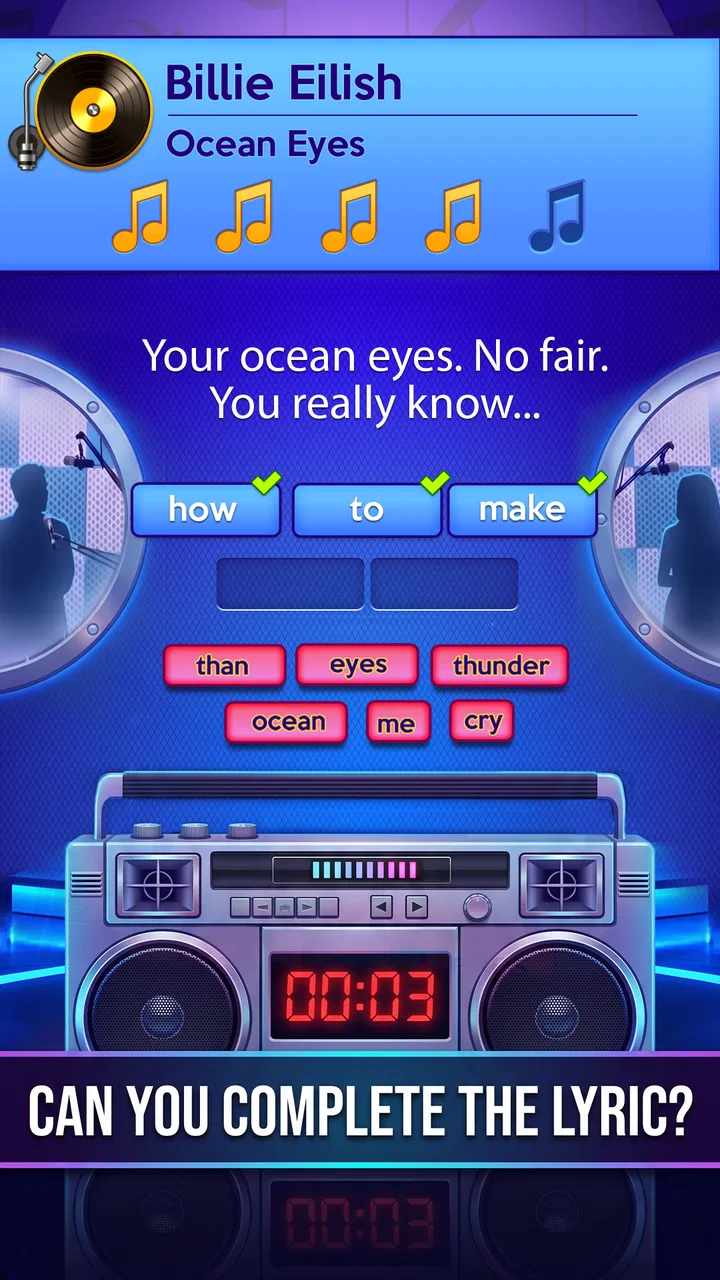
I found Don't Forget the Lyrics most enjoyable when I treated it as a quick social challenge rather than a serious music-learning tool. Its central idea is easy to understand: listen, remember the missing words, and see who can recognize a song lyric first. That simplicity gives it an immediate appeal, especially when several people are sitting together and want something lighter than a full board game or a competitive quiz with complicated rules.
This is a free music game from Music Games & Trivia Games & Trombone - LB ART, aimed at Everyone. It has been available since September 28, 2012, and its continued audience is reflected in an average rating of 4.3 from around 76 thousand ratings. More than 5 million installs show that it has reached far beyond a small niche of lyric enthusiasts.
My overall view is positive, with an important qualification: the game works best when the people playing already enjoy popular songs and do not mind the occasional disagreement over what a lyric actually says. It is fast to pick up, suitable for casual sessions, and naturally encourages conversation. However, anyone looking for a deep music database, precise learning feedback, or a highly polished competitive experience may find it too limited.
You May Also Like

 Blood Strike: 2.5 Anniversary
Blood Strike’s Loadouts Turn Every Drop Into a Tactical Gamble
A close look at Blood Strike’s custom loadouts: how fast access to signature weapons reshapes its battle royale rhythm, rewards preparation, and narrows the gap between fights.

 Pandora - Music & Podcasts
Pandora’s Music Is Easy to Start, but Harder to Recover
Pandora’s strength is its low-effort path from a seed to a station. Its weak spot is how much confidence it asks you to place in connection, setup, and quiet recovery.

 8 Ball Pool
 Is Built on Rivalries, Rematches, and Routine
A close look at the rivalries, rematches, shared routines, and unanswered safety questions that turn a quick pool match into a persistent mobile community.

 Samsung Music
’s Quiet Strength Is Playing What You Already Own
Its reach comes less from spectacle than from dependable access to a personal library. That simplicity is both the app’s strongest retention engine and its ceiling.

 AccuWeather: Weather Radar
AccuWeather Review: A Quick, Clear Forecast for Everyday Decisions
For everyday plans, the best forecast is the one you can understand quickly. AccuWeather makes rain timing, radar, and local conditions easy to act on, with a few trade-offs.

 Hill Climb Racing
Why Hill Climb Racing Still Turns Crashes Into One More Run
A tiny car, a bumpy hill and one more upgrade: Hill Climb Racing keeps resurfacing because its simple chaos makes every near-miss feel personal.
More From Our News Desk



Why the lyric-guessing format works so well
The strongest part of the experience is the low barrier to entry. Nobody needs to study a rulebook before starting. The basic task is familiar from those moments when a song suddenly stops in your head and you try to complete the next line from memory. Turning that everyday experience into a game makes the first round feel approachable even for people who do not normally play mobile quizzes.
I also like that the format tests more than simple recognition. Knowing a song is not always enough; you have to recall the exact wording, or at least enough of it to make a confident choice. That creates a useful distinction between “I know this track” and “I can actually finish the line.” In a group, that difference produces plenty of amusing mistakes without requiring the game to become aggressive or overly competitive.
A realistic use case is a family gathering where conversation has slowed down but nobody wants to commit to a long activity. One person can start a round, others can join in from the same room, and the group can pause naturally to debate an answer or sing the missing phrase. It also fits a short break better than many traditional quiz games because the premise is instantly visible. I would be comfortable suggesting it for a relaxed evening, a car ride when one person is not driving, or a casual get-together with friends who share a broad taste in music.
The social value comes from the discussion around each answer. People often remember the melody, the singer, or where they first heard a song before they remember the exact lyric. That makes the game a conversation starter rather than just a sequence of questions. In my experience, the best moments are not always the correct answers; they are the confident wrong answers and the stories that follow them.
It rewards memory, listening and shared music knowledge
The game is particularly appealing for players who enjoy music trivia but do not want a formal trivia application. Traditional quiz apps often ask about release details, artists, albums, or chart history. This one keeps the focus closer to the song itself. You are not being tested on whether you know a fact about an artist; you are being asked whether the words stayed in your memory.
That focus makes it accessible to mixed groups. A person who knows little about music history can still perform well if they listen closely and remember lyrics. At the same time, a dedicated fan may have an advantage because familiar songs can be completed almost automatically. The balance depends heavily on the group’s shared listening habits, which is both a strength and a weakness.
A useful tactic is to avoid answering too quickly when a line feels obvious. I found that the first lyric that comes to mind is sometimes the version I have invented through years of mishearing a song. Waiting a moment and comparing the phrase with the rhythm or surrounding words can prevent easy mistakes. In a group, this also gives quieter players time to contribute instead of letting the fastest person dominate every round.
Another practical tip is to use the game as a warm-up rather than the entire evening’s entertainment. A few rounds can reveal which genres or eras the group knows best. Once the questions begin to feel repetitive for the same players, switching to another activity keeps the experience fresh. The title is most effective as a compact social game, not as an all-night replacement for every other kind of music quiz.
Simple presentation, with a few trade-offs
The uncomplicated design is a benefit for casual users. You can focus on the lyric challenge rather than navigating a maze of systems. This matters when the audience includes relatives or friends who are comfortable with phones but do not enjoy learning a new interface. The game’s purpose is apparent quickly, and that clarity contributes to its pick-up-and-play character.
At the same time, simplicity means the experience may feel less substantial to players who expect extensive progression. If your ideal music game includes detailed profiles, elaborate competitive leagues, advanced statistics, or a long-term collection system, this is probably not where you will find the most satisfying depth. I would describe it as a compact quiz experience: its value comes from the moment-to-moment guessing, not from building a complex digital career.
The age rating of Everyone makes the concept suitable for broad household use, but suitability is not the same as universal appeal. Younger players may not recognize the same songs as older relatives, while adults with very specific musical tastes may encounter questions outside their comfort zone. The best sessions happen when players accept that the game’s song selection may not match every individual’s personal playlist.
That is why I recommend agreeing on a relaxed attitude before starting. Treating every uncertain answer as a dispute over musical knowledge can quickly drain the fun. Treating it as a prompt to compare memories works much better. The title is at its strongest when the group laughs at imperfect recall instead of expecting a flawless examination.
Where the experience falls short
The biggest limitation is the dependence on recognition. If the selected songs are unfamiliar to you, the challenge can feel less like a test of memory and more like a guess with little useful information behind it. Players who prefer questions with clear reasoning may find that frustrating. A history question can often be solved through deduction; an unknown lyric usually cannot.
This also affects replay value. A group with overlapping musical tastes may enjoy returning to the game, but the novelty of familiar prompts can fade once everyone has seen the same material repeatedly. The experience is therefore more durable for occasional use than for daily play. I would not install it expecting a new, endlessly varied challenge every time I open it.
Another point to consider is the difference between a lyric game and a music education app. Don't Forget the Lyrics can encourage recall and make people pay closer attention to words, but I would not use it as a structured way to improve language comprehension, pronunciation, or vocal technique. It offers entertainment through recognition, not a lesson plan with measurable progress.
There is also a practical cost consideration. The game is free to install, but in-app purchases range from $0.99 to $99.99 per item. That broad range means I would check the purchase screen carefully before confirming anything, particularly if a child is using the device. The free entry point is attractive, yet the presence of optional spending makes it sensible to decide in advance whether the basic experience is enough for your household.
Its current version is 1.9.0, and it supports devices running Android 7.0 or later. For many users, that requirement should be manageable, but anyone holding on to an older phone should check compatibility before planning a group session. This is a small detail, but it matters when the game is intended for a family device or an older spare handset.
I would also skip this game if you want a large-scale multiplayer competition with a highly controlled ranking environment. Its charm is informal and immediate. Players who need carefully balanced difficulty, extensive performance tracking, or a more serious esports-style structure should look toward a specialized trivia platform instead. Here, the social mood matters more than proving who is the definitive authority on lyrics.
Who will get the most from it
The ideal player is someone who enjoys singing along, remembers fragments of songs, and likes comparing music memories with other people. It is especially well suited to families and friendship groups with overlapping playlists. The game can bridge age differences surprisingly well when one person knows the melody and another remembers the words, even if neither can provide the answer alone.
It also suits people who want a brief distraction without committing to a long campaign. A few rounds can fill an awkward pause, provide a change of pace during a gathering, or turn a quiet evening into a small competition. Because the premise is familiar, it does not demand the same concentration as a strategy game or the same time investment as a story-driven title.
Music fans who enjoy arguing about exact wording may find an extra layer of entertainment here. I recommend keeping a device or another source nearby only if the group genuinely wants to settle a disputed line afterward; looking everything up immediately can interrupt the rhythm. Letting some uncertainty remain often keeps the conversation more playful.
On the other hand, I would not make this my first recommendation for someone who rarely listens to songs with memorable lyrics, dislikes guessing games, or wants a private activity with a strong sense of progression. Solo players can still appreciate the challenge, but the format gains much of its personality from shared reactions. If you prefer quiet, structured practice, a dedicated language or music-learning application would likely be a better fit.
For parents, the Everyone rating is reassuring as a general content classification, but I would still supervise purchases on a shared device. The game itself is easy to explain to children, yet their enjoyment will depend on whether the available songs feel familiar. It works best when an adult is willing to play along rather than simply hand over the phone.
How I would use it for the best session
I would begin with a small group and keep the first session short. Start by letting everyone answer independently, then compare responses after each lyric. This avoids one confident player announcing an answer before others have had a chance to think. It also reveals whether the group’s musical knowledge is broad enough to support longer play.
For a family setting, I would pair players with different strengths. Someone who recognizes melodies quickly can work with someone who remembers wording accurately. That arrangement reduces the advantage of one narrow type of musical memory and makes the game feel more cooperative without removing the competitive element.
For friends, I would use a simple house rule: explain why an answer seems right before declaring victory. This turns a lucky guess into a conversation about rhythm, phrasing, and memory. It is a small adjustment, but it makes the experience more engaging for people who are not naturally fast at quizzes.
I would also avoid judging the game after only one awkward round. A poor match between the group’s tastes and the selected songs can make the title seem weaker than it is. Give it another try with different players or at a different gathering. The game’s quality is closely tied to the social chemistry around it, more so than with a solitary puzzle.
My verdict after weighing the fun against the friction
Don't Forget the Lyrics succeeds because it understands the pleasure of almost remembering a song. It transforms a familiar musical habit into a quick challenge that is easy to share. The strongest evidence in its favor is not complexity but accessibility: people can start talking, guessing and laughing without first learning an elaborate system.
Its weaknesses are equally clear. The experience depends on song familiarity, replay value can vary between groups, and it does not offer the depth of a dedicated music-learning or competitive trivia product. The in-app purchase range also deserves attention before allowing unrestricted use on a shared device. These are not deal-breakers for casual players, but they should shape expectations.
With 5M+ installs and a 4.3 average, it has clearly found an audience, and I can understand why. The game is free to begin, carries an Everyone rating, and comes from a developer focused on music and trivia games. I would recommend it to friends who want a light group activity built around songs they already enjoy.
My final recommendation is simple: install it for occasional social play, not as a replacement for a full music library, a learning course, or a deep competitive quiz. If your group likes singing along and can laugh at imperfect memories, it can turn a few spare minutes into a genuinely entertaining session. If you need precision, variety on demand, or long-term progression, choose a more specialized alternative instead.
FAQs for Don't Forget the Lyrics
01What is the main objective of Don't Forget the Lyrics?
The main objective of Don't Forget the Lyrics is to test your knowledge of song lyrics by challenging you to fill in the missing words of popular songs. As you progress, the difficulty increases, requiring a keen memory and a love for music to succeed. It’s a fun way to test and expand your lyrical knowledge.
02Is Don't Forget the Lyrics free to play?
Don't Forget the Lyrics is free to download and offers a variety of gameplay options without charge. However, the app includes in-app purchases that provide additional features or remove ads. These purchases are optional, and you can enjoy the core gameplay without spending money.
03What types of songs are included in the app's library?
The app boasts a vast library of songs across multiple genres and decades. From classic hits to contemporary chart-toppers, there's a wide range of music to choose from. This diversity ensures that music lovers of all tastes can find songs they know and enjoy the challenge of completing the lyrics.
04Can I play Don't Forget the Lyrics offline?
Yes, Don't Forget the Lyrics offers an offline mode, allowing you to play without an internet connection. This feature is perfect for users who want to enjoy the game on the go, without worrying about data usage or connectivity issues. However, some features may require an internet connection.
05Does the app offer multiplayer or social features?
Don't Forget the Lyrics includes social features that allow you to challenge friends or compete against other players worldwide. You can share your scores, invite friends to play, and even participate in leaderboards. These features add a competitive edge and enhance the overall gaming experience.
Pros
- Engaging gameplay with popular music hits.
- Intuitive interface for easy navigation.
- Regular updates with new song packs.
- Multiplayer mode enhances competition.
- Offline play available for on-the-go fun.
Cons
- Limited free songs without purchases.
- Ads can be intrusive during gameplay.
- Requires internet for some features.
- Occasional bugs with lyric recognition.
- Some songs may not have full lyrics.

Don't Forget the Lyrics
Gallery